Your Amana washing machine starts a cycle, fills with water, and then immediately begins draining. Or maybe the drain pump runs randomly, even when the machine is unplugged. You are left staring at an empty tub, unable to wash clothes, and wondering why your washer won’t stop draining.
This is a frustrating issue, but the good news is most cases of an Amana washing machine keeping draining stem from one of three fixable causes: improper installation causing siphoning, a failed pressure sensor, or a malfunctioning control board. This guide walks you through diagnosing and fixing each one, starting with free checks you can do today.
Check Drain Hose Depth to Stop Siphoning
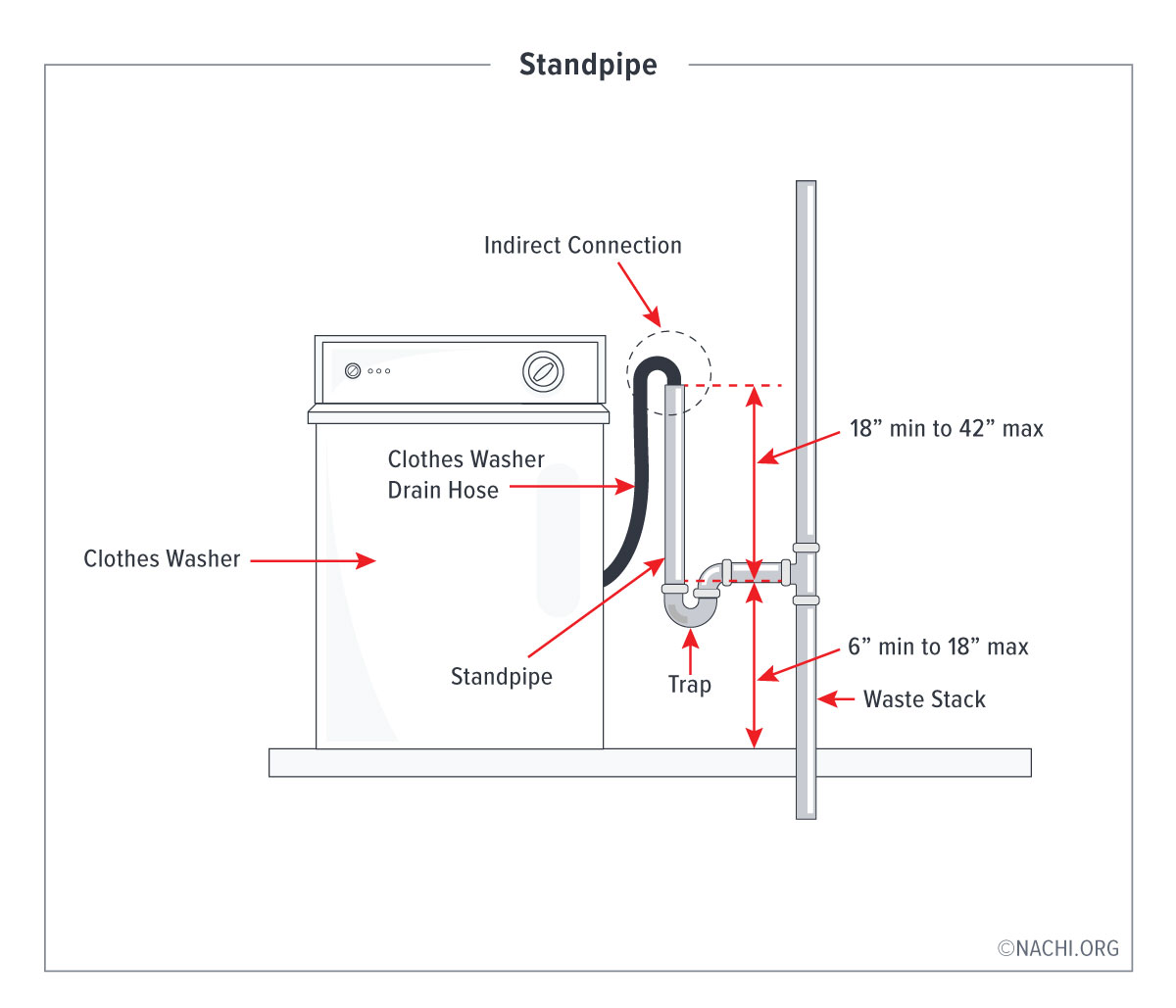
If your Amana washer drains as it fills, or if water cycles in and out repeatedly, siphoning is likely the culprit. This happens when the drain hose is inserted too far into the standpipe.
Insert Hose No More Than 4.5 Inches
The drain hose must extend no more than 4.5 inches (113 mm) into the laundry standpipe. Deeper insertion creates a vacuum seal that pulls water out continuously.
What to do:
• Pull the hose back so only 4 inches enter the pipe
• Use the included U-shaped drain hose form to maintain proper depth
• Secure the hose with a hook or clip, never tape it in place
Visual cue: If water flows out the moment it enters the tub, siphoning is active.
Confirm Standpipe Height Meets Requirements
Even with correct hose depth, a low drainpipe can cause gravity-fed drainage that triggers constant draining.
Meet the 30-Inch Minimum Height
The top of your standpipe must be at least 30 inches (76.2 cm) from the floor. Anything lower allows water to flow out by gravity, creating suction that triggers continuous draining.
How to check:
• Measure from the floor to the top of the pipe
• If below 30 inches, raise the pipe using an extension
• Ensure the drain loop is higher than the washer’s cabinet
Pro tip: Never seal the hose-to-pipe connection. Air must enter to break the siphon.
Eliminate Air Gap Sealing
A sealed drain hose creates a closed system that promotes siphoning, making your Amana washing machine keep draining unexpectedly.
Keep the Connection Loose
The drain hose should fit loosely inside the standpipe. Do not use tape to secure it.
Why it matters:
• A tight seal prevents air from entering
• Without airflow, water siphons out as it fills
• This mimics a stuck-open drain pump
Fix: Remove any tape or clamps sealing the hose to the pipe. Let air circulate freely.
Perform a Factory Reset
If installation is correct but the pump still runs, try a factory reset. This clears error codes and resets the control logic, often stopping erratic pump behavior.
Follow the Reset Sequence Exactly
- Unplug the washer or turn off the circuit breaker
- Wait 10 seconds, then plug it back in
- Rotate the cycle knob counterclockwise one full turn (360 degrees)
- Within 6 seconds, press Right 3 times, then Left 1 time, then Right 1 time
- When lights flash, turn the knob 4 clicks to the right
- Press Start
Success signs include:
• Lid unlocks
• Machine powers down completely
• No lights remain on
Wait 2 minutes, then restart a normal cycle.
When it helps:
• Pump runs after cycle ends
• Control panel is frozen
• Error codes like F02, UE, or SD are present
Diagnose Pressure Transducer Failure

If the reset fails, the pressure transducer (water level sensor) is likely faulty. A bad sensor tells the control board the tub is full even when empty, triggering constant drainage.
Why It Fails
• Suds lock: Too much detergent creates foam that blocks the pressure hose, fooling the sensor
• Electrical failure: Moisture, age, or poor contact corrupts readings
• Pin issues: Though 8-pin, only 3 carry signals. Corrosion on these pins causes errors
Test for Suds Lock First
- Run a clean cycle with no clothes
- Use washer cleaner or white vinegar (no detergent)
- Check if the problem stops
Prevention: Always use HE detergent and follow dosage guidelines. Use one tablespoon per load.
Replace the Pressure Transducer
Replacing the full control board costs over $200. But the pressure transducer itself costs just $20. For those with basic soldering skills, this is a cost-saving repair.
Tools and Preparation Needed
• Soldering iron set to approximately 800°F
• Solder wick or desoldering pump
• New transducer (fits Whirlpool and Amana boards)
Step-by-Step Replacement Process
- Power off and unplug the washer
- Remove the back panel to access the main control board
- Locate the transducer: small silver cylinder with a notch on the board
- On the back of the board, heat each solder joint and use solder wick to remove old solder
- Clear all 8 holes completely before removing the old transducer
- Insert the new transducer, aligning the silver mark with the board notch
- Solder each pin with clean, shiny joints, avoiding bridging adjacent pins
- Reassemble and test
Warning: Boards have a protective varnish coating. Heat slowly to avoid damaging traces.
Replace the Control Board
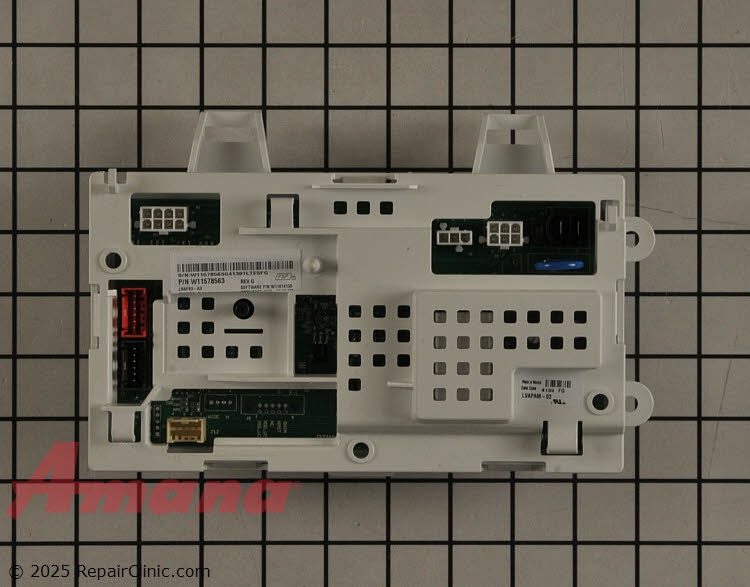
If the transducer is good but the pump still runs randomly, especially when unplugged or during fill, the main control board is likely dead.
Symptoms of Board Failure
• Pump runs immediately on power-up
• Control panel is unresponsive while draining
• Power button won’t stop the pump
• Unit is under 2 years old (points to electronic defect, not wear)
Part Information
• Part Number: W11607637 (also PD00087731)
• Cost: $200 or more
• Models Affected: 2023 Amana top-loaders with 3 left-side knobs and center timer
Replacement Steps
- Unplug the washer
- Remove the top panel (usually clips or screws at the back)
- Disconnect wires from the old board
- Remove mounting screws
- Install the new board, matching all connectors
- Reassemble and test
Pro tip: Take photos before disconnecting wires to ensure correct reconnection.
Interpret Error Codes
Your washer communicates problems through blinking lights and error codes.
What F02 Means
F02 indicates a drain pump error. Action: Check for blockages, run reset, test pump operation.
What UE Indicates
UE means unbalanced load, but it can be triggered by control board glitches. Try reset before redistributing laundry.
What SD Signals
SD means suds lock. Cause: excess suds detected. Fix: run vinegar cycle, reduce detergent, replace transducer if persistent.
Prevent Future Drain Issues
Avoid repeat failures with these simple habits.
Use HE Detergent Only
• Standard detergent creates too many suds
• HE formula is low-suds, high-efficiency
• Use one tablespoon per load, less for small loads
Inspect Hose Annually
• Ensure the drain hose has not slipped deeper into the standpipe
• Confirm no tape or sealant is used
Reset Early
At the first sign of pump running post-cycle, slow filling, or flashing lights, do a factory reset immediately. This can stop minor glitches before they lock out the system.
When to Call a Technician
Skip DIY if you lack soldering experience, see visible burn marks or corrosion on the board, hear clicking or burning smells during operation, or are uncomfortable working with electrical components. A pro can test the pump, motor, and board with a multimeter and confirm the exact fault.
Frequently Asked Questions About Amana Washing Machine Draining Issues
Why does my Amana washer drain continuously even when not in use?
This is typically caused by a failed pressure transducer sending false signals to the control board, or a malfunctioning control board that keeps the pump activated. A factory reset may resolve this if the issue is electronic glitch rather than hardware failure.
Can a drain hose cause my washing machine to keep draining?
Yes. If the drain hose is inserted more than 4.5 inches into the standpipe, it creates a siphon effect that pulls water out continuously. Also ensure the hose is not sealed with tape, as this prevents the air gap needed to break the siphon.
How much does it cost to fix a draining Amana washer?
Costs range from free (factory reset or hose adjustment) to $20 for a pressure transducer replacement. Full control board replacement costs $200 or more. Start with free fixes before spending money on parts.
What does the F02 error code mean on my Amana washer?
F02 indicates a drain pump error. This means the pump is either clogged or not responding properly. Check for blockages in the drain hose or pump, then try a factory reset to clear the error.
Can I replace just the pressure transducer instead of the whole control board?
Yes. The pressure transducer is a separate component on the control board and costs approximately $20. With basic soldering skills, you can replace just the transducer instead of spending $200 on a new board.
How do I stop my Amana washer from siphoning?
Ensure the drain hose extends no more than 4.5 inches into the standpipe, keep the connection loose (no tape), and verify the standpipe is at least 30 inches high. These adjustments prevent the vacuum seal that causes siphoning.
Key Takeaways for Fixing Your Amana Washing Machine

An Amana washing machine keeps draining due to siphoning, a failed pressure sensor, or a bad control board. Start with free, no-tool checks: verify the drain hose depth is 4.5 inches or less, ensure the standpipe is at least 30 inches high, and confirm no tape seals the connection. If these are correct, perform a factory reset to clear electronic glitches. For recurring issues, replace the $20 pressure transducer before spending $200 on a new control board. With the right troubleshooting steps, you can stop the drain cycle and get back to clean laundry without replacing the whole machine.