Your Amana washing machine fills with water but refuses to drain, leaving you with a tub full of dirty, standing water. This is one of the most common appliance problems homeowners face. The good news? In over 90% of cases, especially on Whirlpool-built Amana models, the problem is not a broken part but a simple blockage or reset issue you can fix in under 15 minutes.
This guide walks you through every possible cause, from quick resets to internal pump jams. You will learn how to diagnose the exact issue using sounds, smells, and smart troubleshooting so you avoid unnecessary part replacements. Whether it is a sock stuck in the pump, a siphoning drain hose, or a control glitch after a power surge, you will find the solution here.
Reset Your Amana Washer First
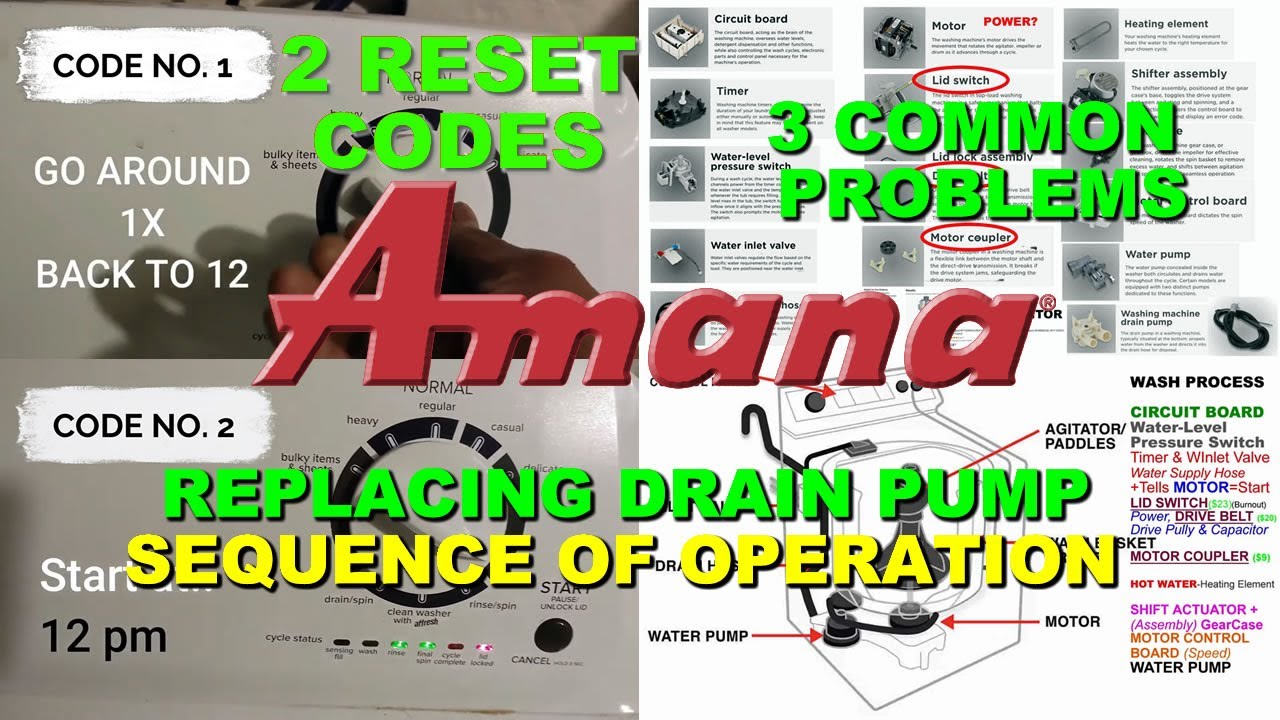
Before taking anything apart, try these two resets. Many drainage failures are caused by temporary software locks or sensor errors, especially after moving the machine or a power flicker.
Perform a Power Reset
This clears soft error codes and restarts the control board. Follow these steps exactly:
- Unplug the washer for 60 seconds.
- Plug it back in.
- Immediately lift and close the lid six times within 12 seconds.
- Select a spin or drain cycle and press Start.
If the machine drains, the issue was a software glitch. No disassembly needed.
Pro Tip: This reset works on most Amana top-load models. If it does not trigger a response, move to the advanced diagnostic reset.
Run the Diagnostic Mode Reset
For Amana washers built by Whirlpool, this enters factory diagnostic mode to test internal components. Use this sequence:
- Turn the cycle dial to 12:00 (Off).
- Rotate it clockwise one full turn, back to 12:00.
- Press the control buttons in this order: Left, Right three times, Left, Right.
- All lights should turn off. This confirms entry.
- Press Right twice to select Final Rinse.
- Press Start.
The washer will run a self-test, including a drain cycle. If it drains during this test, the pump and motor are functional. The issue was a sensor or software lock.
Note: If the machine does not respond at all, check power supply and outlet functionality first.
Check Drain Hose Setup and Installation
Improper installation causes more drainage issues than mechanical failure. Even a perfectly working pump cannot overcome poor plumbing.
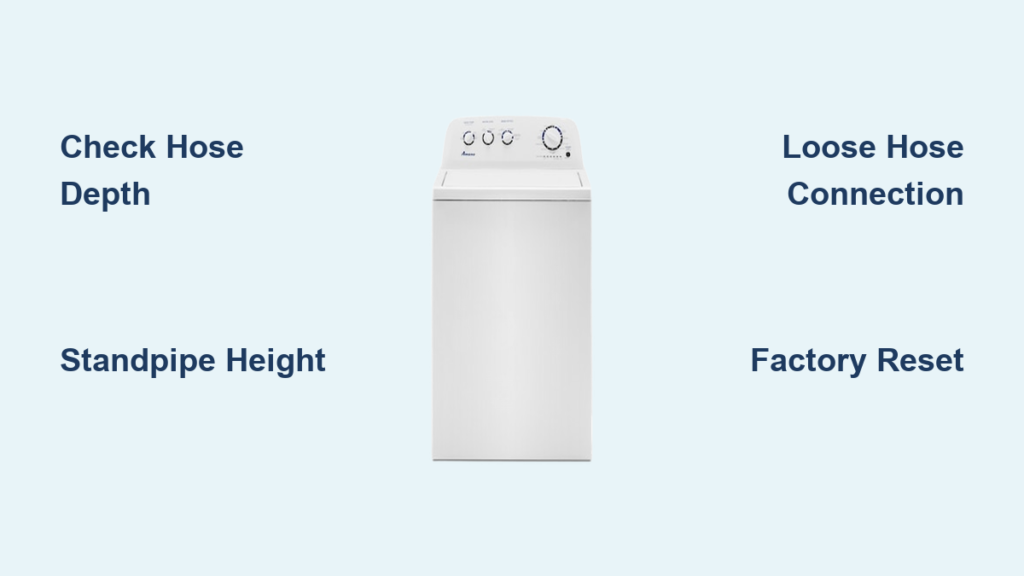
Confirm Standpipe Height
The drainpipe must be between 30 and 96 inches above the floor. Here is why this matters:
- Below 30 inches: Water siphons out during fill, preventing proper operation.
- Above 96 inches: The pump cannot push water high enough. It flows back into the tub.
Use a tape measure to verify. Adjust the hose height if needed.
Prevent Siphoning
Siphoning happens when the drain hose creates a sealed loop, sucking water out prematurely or failing to drain. Fix it by doing these things:
- Insert the hose no more than 4.5 inches into the standpipe.
- Never tape or seal the hose into the pipe.
- Use the U-shaped hose clamp to hold the hose in place with an air gap.
Visual Cue: If water slowly drains when the machine is off, siphoning is likely.
Inspect for Kinks and Clogs
Pull the washer forward and examine the entire hose path. Look for these issues:
- Kinks, bends, or crushing behind the machine.
- Lint or debris trapped inside the hose.
- Clogs in the utility sink or standpipe.
Disconnect the hose and flush it with water to clear debris. Use a plumber’s snake if needed.
Warning: Never run the washer with a kinked or blocked drain hose. It can burn out the pump.
Clear Pump and Filter Blockages

Physical obstructions are the most common cause of drainage failure. Coins, hair, socks, and lint can jam the pump impeller.
Clean the Drain Pump Filter
Many Amana models have a front-access filter that traps debris. Follow these steps:
- Place towels or a pan under the front lower panel.
- Open the access panel (usually at the bottom front).
- Unscrew the filter cap slowly. Expect 1 to 2 cups of water to spill.
- Remove lint, coins, and gunk from the filter and pump cavity.
- Reinstall and tighten the cap.
Maintenance Tip: Clean this filter every 3 to 6 months to prevent clogs.
Remove Internal Pump Debris
On Whirlpool-built Amana washers, clothing like gloves or boxers can bypass the filter and jam directly in the pump chamber. Access the pump by doing these things:
- Unplug the washer.
- Remove three 1/4-inch nuts from the back panel (they secure the front panel).
- Unscrew the two top front screws.
- Gently pull the front panel up and forward to detach.
- Locate the pump housing. It is a round plastic unit with hoses attached.
- Pry off the pump cover using a flathead screwdriver on the tabs.
Extract blockages using long needle-nose pliers to pull out socks, underwear, or other items. Spin the impeller by hand. It should turn freely. Reassemble and test.
Success Rate: This fix resolves 90% of drainage issues on compatible Amana models. Total time is under 15 minutes.
Test the Drain Pump Motor
If no blockages are found and the hose setup is correct, test the pump electrical and mechanical function.
Check for Continuity
Use a multimeter to test if the pump motor is electrically intact. Follow these steps:
- Disconnect power.
- Unplug the pump wiring harness.
- Set multimeter to Ohms (Ω).
- Touch probes to the pump terminals.
Results:
- Reading between 5 and 30 Ω: Pump is electrically sound.
- No reading (OL): Motor is dead. Replace the pump.
Note: A good continuity reading does not guarantee mechanical function. Test further.
Perform a Direct Power Test
Bypass the control board to see if the pump runs on its own. Use an old extension cord and follow these steps:
- Cut the female end off an old extension cord.
- Strip the wires and attach alligator clips.
- Connect clips to the pump terminals.
- Plug into a wall outlet briefly (1 to 2 seconds).
Observe:
- Pump spins fast: Pump is good. Problem is elsewhere (control board, lid lock).
- Pump hums but will not spin: Motor is seized or impeller is stuck.
- No response: Pump is dead, even if continuity was good.
Warning: Never hold the cord plugged in for more than 3 seconds. This is a diagnostic test only.
Replace the Pump If Needed
Replace the drain pump if it fails continuity, hums but does not spin, runs but does not move water, or has terminals showing corrosion that cannot be cleaned.
Pro Tip: Use OEM or high-quality aftermarket pumps. Cheap replacements often fail within months.
Diagnose Control Systems and Safety Sensors
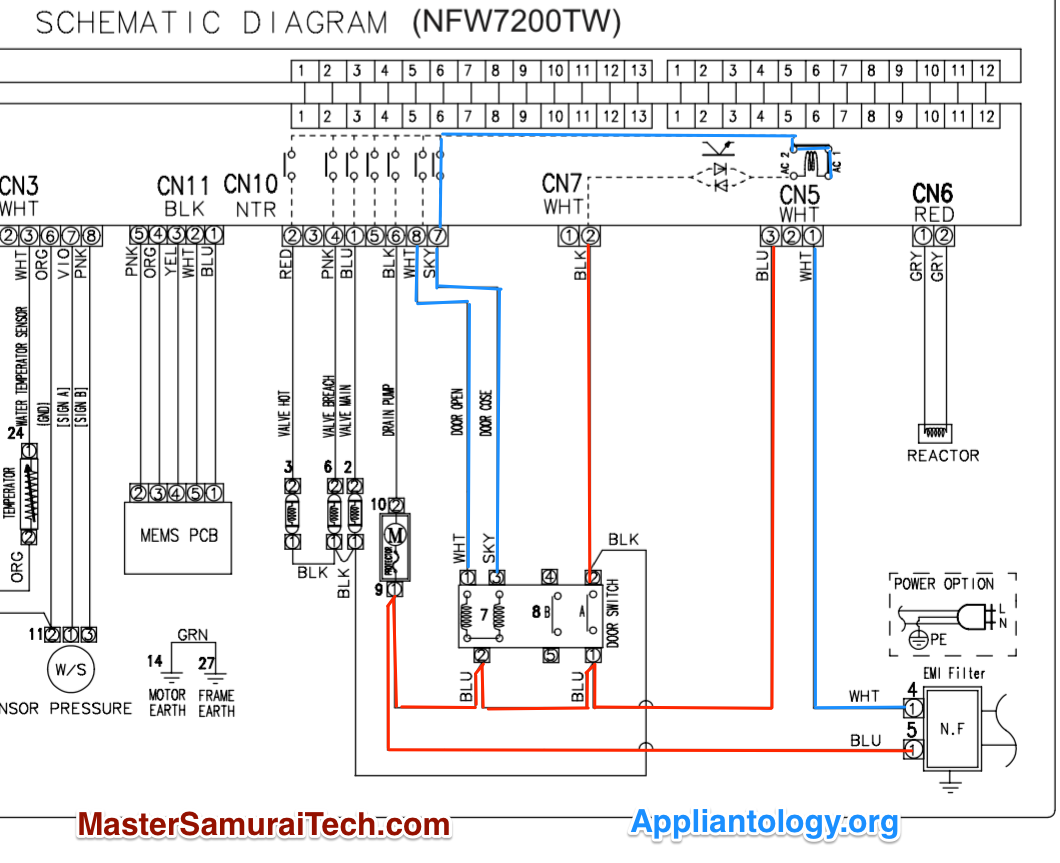
The washer will not drain if safety sensors detect a fault. These systems block power to the pump even if it is functional.
Test the Lid Lock or Door Switch
The machine will not drain unless the lid or door is securely closed. Test the switch by doing these things:
- Unplug the washer.
- Locate the lid lock switch (near the lid strike).
- Use a multimeter to test for continuity when the lid is closed.
- If no continuity, replace the switch.
Quick Check: If the pump runs with direct power but not during a cycle, the lid lock is a prime suspect.
Inspect the Pressure Switch and Hose
The pressure switch tells the control board how much water is in the tub. Troubleshoot by following these steps:
- Locate the pressure switch (usually on the control panel or side of tub).
- Disconnect the thin air hose attached to it.
- Blow through the hose to clear any clogs.
- Check for cracks or water inside the hose.
- Reconnect and test.
User Insight: A clogged pressure hose has been the sole cause in verified repair cases. Cleaning it restored full function.
Evaluate the Control Board
If all other components test good, the control board may not be sending power to the pump. Look for these signs:
- No error codes, but pump gets no power.
- Burn marks or corrosion on the board.
- Intermittent operation.
Inspect wiring harnesses for loose or corroded connections. If connections are good and components test fine, replace the control board.
Note: Control board failure is rare. Only suspect it after ruling out all other causes.
Inspect the Drive Belt (Select Models)
Some Amana top-load washers use a belt to drive both the drum and pump. Inspect by doing these things:
- Unplug the washer.
- Remove the back panel or lower access panel.
- Check the belt for cracks, fraying, or looseness.
- Ensure it is seated on the motor and pump pulleys.
If broken or slipped, replace the belt and check pulley alignment.
Note: A broken belt stops agitation and spinning, which may delay or prevent drain cycles on certain models.
Follow This Troubleshooting Flowchart

Use this step-by-step logic to diagnose efficiently.
Step 1: Verify Installation
Check these items:
- Is the drain hose 30 to 96 inches high?
- Is it inserted less than 4.5 inches into the standpipe?
- Is there an air gap? No kinks?
Step 2: Reset the Machine
Try the 60-second power plus lid-lift reset. If no response, run the diagnostic mode reset.
Step 3: Clear Blockages
Clean the drain pump filter. Inspect the drain hose. Open the pump chamber and remove debris.
Step 4: Test Key Components
Listen for these sounds:
- Humming: Power to pump, likely blockage or seized motor.
- Silence: Electrical issue.
Test lid lock for continuity. Check pressure switch hose for clogs. Test pump with multimeter and direct power.
Step 5: Replace or Repair
Replace pump if failed tests. Swap lid lock or pressure switch if faulty. Replace control board only as last resort.
Prevent Future Drain Issues
Avoid repeat problems with these simple habits:
- Clean the pump filter every 3 to 6 months.
- Check pockets before washing. Coins and tissues cause clogs.
- Use the U-clamp to secure the drain hose at the correct height.
- Do not overload. Tight loads trap water and strain the pump.
- Run a cleaning cycle monthly with washer cleaner or vinegar.
Pro Tip: If you have recently moved the washer, always run the diagnostic reset. Transport can jostle sensors and trigger false errors.
Frequently Asked Questions About Amana Washing Machine Not Draining
Why does my Amana washer fill with water but will not drain?
This usually indicates a blockage in the drain pump or filter, a kinked drain hose, or a software glitch. Start by cleaning the filter and running a diagnostic reset. These steps resolve the majority of cases.
How do I know if my drain pump is broken?
Listen for specific sounds. A humming noise means the pump is receiving power but cannot move water. Silence during the drain cycle means no power is reaching the pump. Test with a multimeter or direct power to confirm.
Can a sock really clog my washing machine drain?
Yes. Small items like socks, underwear, and coins are the most common cause of pump blockages. They can bypass the filter and jam directly in the pump impeller. Opening the pump chamber often reveals the culprit.
What is the correct drain hose height for an Amana washer?
The drain hose must be between 30 and 96 inches above the floor. Below 30 inches causes siphoning. Above 96 inches exceeds the pump capacity, causing water to flow back into the tub.
Is it worth replacing the drain pump on an Amana washer?
Yes, if testing confirms the pump is dead. Use OEM or quality aftermarket parts. Cheap replacements often fail within months. The pump is usually the culprit only after ruling out blockages and installation issues.
Key Takeaways for Fixing Your Amana Washer
Most Amana washers not draining are fixed without replacing a single part. Start with resets and blockage checks. These solve the vast majority of cases. The diagnostic reset alone clears software locks that mimic mechanical failure. Cleaning the pump filter and internal chamber removes the debris causing 90% of drainage problems.
Only move to electrical testing and part replacement after confirming no physical or setup issues exist. Test the lid lock and pressure switch before suspecting the control board. With this guide, you will save time, money, and the hassle of a service call.